
What is stopping you writing that article, that LinkedIn post, a blog of your own? What holds you back from doing it more, or doing it with confidence and pizzaz?
Does it sounds like any of these reasons?
“I’m not really a writer.”“I don’t know what to write about.”“Why would anyone want to read my thoughts?”“I don’t have anything original to say.”“I don’t know how to structure it.”“What if people judge it?”These are all things I hear often, especially from people who would quite like to write, but never quite get as far as doing it. The interesting thing is that most of these aren’t writing problems, they are confidence issues!
The trouble is, confidence often comes after you start, not before.
You probably already have something to write about
One of the first barriers is the idea itself. People sometimes imagine that writers have a magical cupboard full of original thoughts waiting to be turned into articles. I certainly don’t. You should see me starting to write my TJ newsletter each week, literally my eyes roaming around my office trying to think about a piece of inspiration for my editorial.
My ideas often come from ordinary things I notice. It might be…
- Something in the industry news
- A recent experience
- A question clients keep asking
- Something in L&D that annoys you
- Something that excites or concerns you
- A conversation you keep thinking about
- A mistake you learned from
- Some useful research
- An opinion you keep returning to
- Something you think people often misunderstand
The idea doesn’t need to be ground-breaking. It just needs to be interesting enough to you that you have something to say about it. I see this all the time with articles people submit to Training Journal: one person might write about standards in instructional design because of conversations happening in their day-to-day work. Someone else might reflect on their journey into a senior leadership role. Another person might spot a connection between something appearing in the news and what they are seeing when recruiting people.
None of those people had to sit down and invent a brand-new concept – they noticed something. That is often where writing starts, and it’s where you can start too.
You don’t need to find your “writing voice”
Another thing people worry about is their voice. They tell me they don’t know what their writing voice is, or they worry they don’t have the right sort of “magazine voice”. I’m not convinced you need to know your voice before you start writing, it emerges through the choices you make.
- What do you notice?
- What do you care about?
- What annoys you?
- What do you find interesting?
- How do you explain something when you are talking to another human being?
- Those things gradually become part of your writing.
You can certainly make conscious choices too. You might decide you want your writing to be more direct, more conversational, more challenging, more evidence-led or more practical. But you don’t have to perfectly define your writing personality before sentence one. Writing is partly how you discover it.

AI can be useful here. If you have examples of things you have written before, you can ask an AI tool to analyse them and describe your style. I’ve done this myself. Apart from telling me lots of nice things I obviously chose to believe immediately, it can also help identify patterns. I can ask how to make something sound more like me, where my writing could be stronger, or what I might consciously do more or less of.
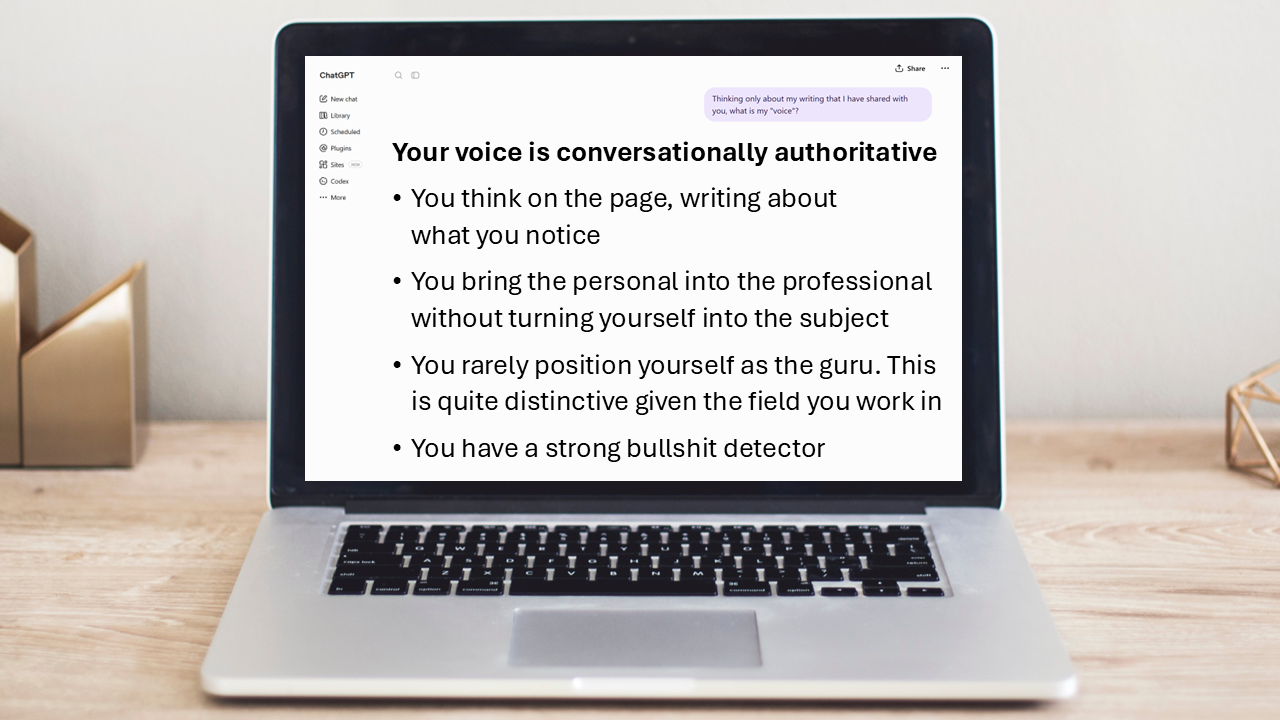
All of this is useful, but the source material still has to come from somewhere. And that somewhere is you.
A topic isn’t quite enough
Let’s say you have decided you want to write about feedback. Great, but “feedback” is enormous. So now it’s about focusing a bit more:
- What is your actual point?
- What is your moan?
- What do you wish people understood?
- What do you wish they would stop doing?
- What would you like them to do differently?
Your answer is the angle of your writing.
A useful question is: What do I want the reader to know, understand or do after reading this?”

You might decide that managers give too much feedback and not enough useful direction. Perhaps you think organisations spend lots of money training people how to give feedback while doing very little about whether anybody wants to receive it. Maybe your argument is that the annual appraisal has given feedback a bad name.
Suddenly, you no longer have an enormous subject, you have something you can write about.
Don’t start with the perfect opening
Then comes the difficult bit, actually writing something. This is where we can make life unnecessarily hard for ourselves: we sit staring at a blank page trying to write a brilliant introduction, wanting the killer opening line, for it to sound polished. We want to know exactly where the article is going. But, because we haven’t written anything yet, we decide we can’t write.
So, let’s not start at the beginning. Start with the bit you already know, the bit that’s stuck in your head, the thing you want to make the impact. Just turn one note into one sentence.
It can be clumsy. It can be too long. It can contain three versions of the same thought. But, guess what, nobody else needs to see it right now. The purpose of that sentence is not to be good, its job is to exist. Then it gets you to the next sentence. So… Write the next sentence. And the next.
No publishing.
No sharing.
No judgement.
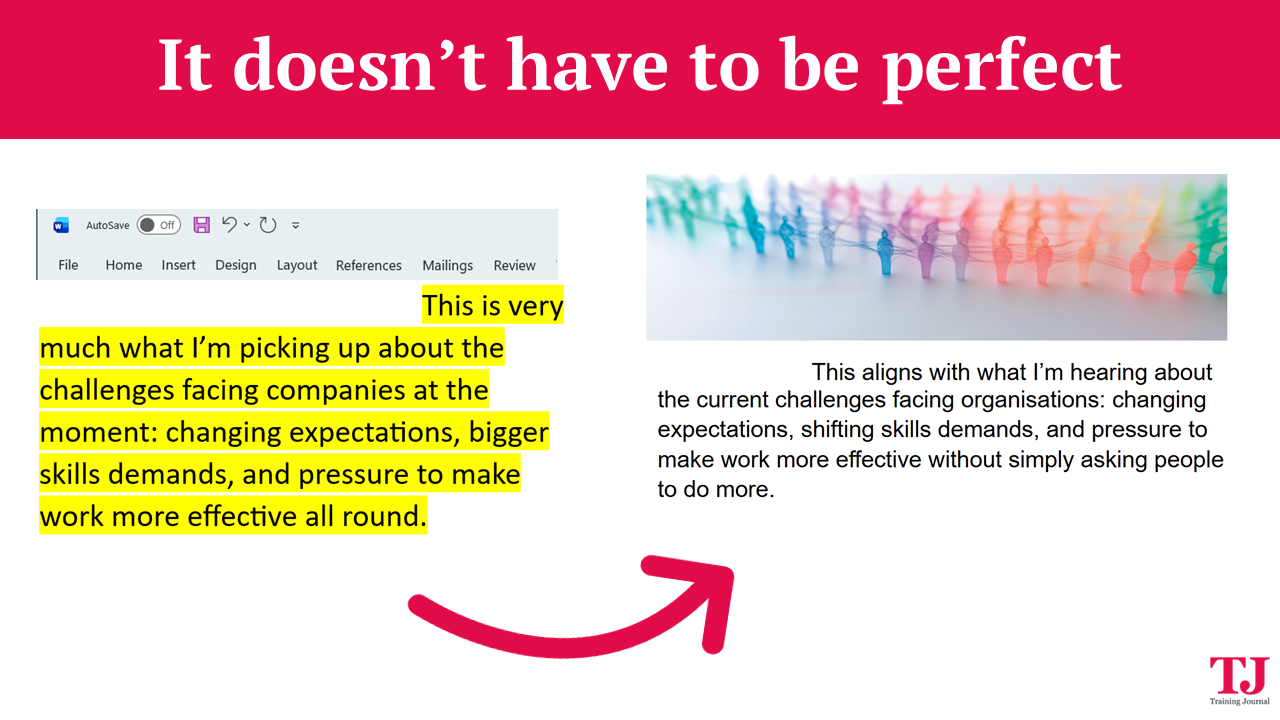
You can edit later, move things around, adjust, delete. But if you have a blank page, that will paralyse you and you’ve got nothing to work on. Just start somewhere.
Some tips and support
This is a really simple structure you can use – probably similar to something you’ve used in other work.
Structure:
- What I have noticed
- Why it matters
- What the reader can do, consider or question
Or these headings/labels might be useful starting points instead.
Labels:
- The situation
- The insight
- The implication to the individual, team, organisation or society
Either way, make brief notes to help you think about what you are going to write.
Sometimes, you might want to ask yourself these questions to help you refine the angle.
Questions:
- What do I believe about it?
- What does the evidence prove/disprove?
- What might a reader think differently afterwards?
- What do I want them to go away and do
- Can I make it more specific?
Yes, you are allowed to use AI
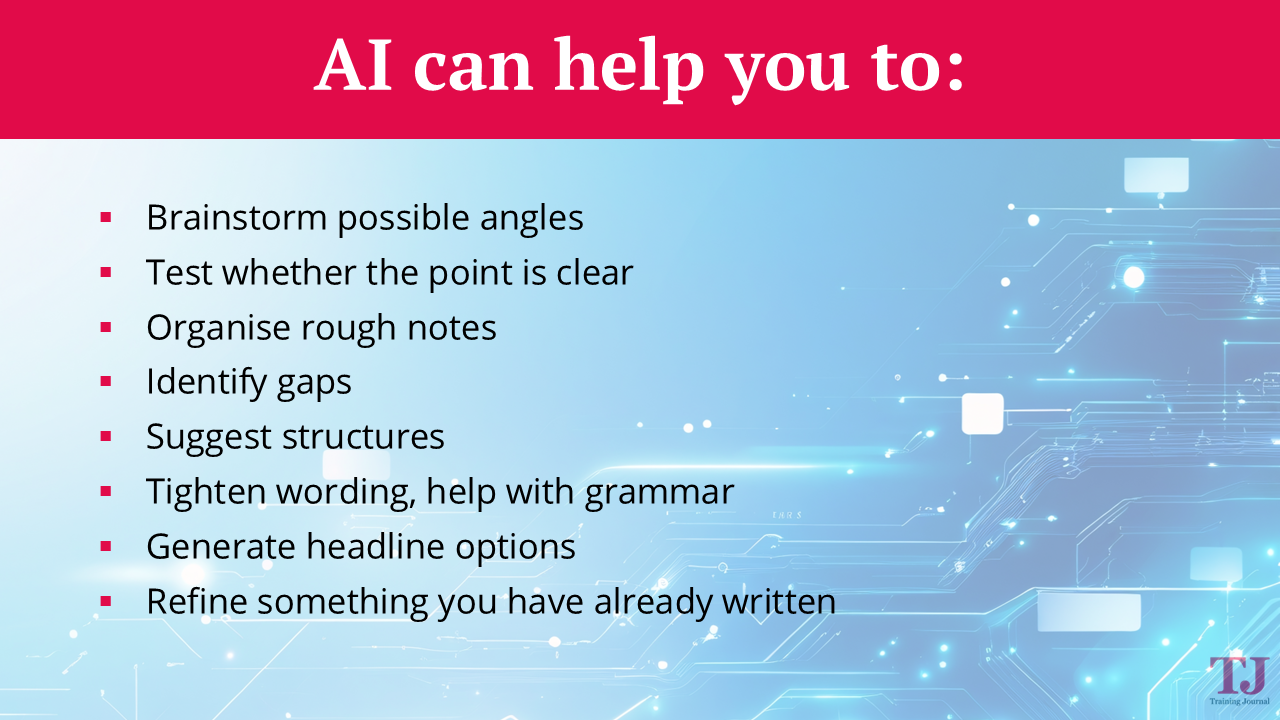
People often ask me where AI fits into all this, particularly when they are writing something that might be published. For the most part, it’s just another tool to use to help you. I use it, I used it on this blog.
Sometimes I use it to organise thoughts, or for alternative wording. Sometimes to challenge an argument or identify a gap. Maybe my brain is have a perimenopausal moment and I have a deadline to meet. AI can help by taking my notes and produce a rough draft – that’s what it did for this blog, from my session plan notes.
But then I edit it. AI can help me with the writing, but it doesn’t have my experiences, or the conversations I was in. It hasn’t noticed the same things I have noticed as it’s not, yet, an actual extension to my brain. It doesn’t know which part made me angry, curious, amused or uncomfortable. It doesn’t know why I keep coming back to a particular idea.
They are the interesting bits, when we start with ourselves (or maybe a client, if we feel less comfortable with the self-promotional aspects). We just use AI where we need support.

The call-to-action bit
So if there’s a Training Journal article, post or half-formed rant that has been sitting in your head for a while, don’t wait until you feel like a writer. Pick the bit you care about, write one sentence, then another, and see where it takes you. Then, suddenly, you have a thing 😀