
People professionals spend a lot of time thinking about other people’s needs: Their learning, capability, performance, wellbeing, careers, workloads, confidence… If you lead an L&D team, you’re probably encouraging people to develop themselves, protect time for important work, ask questions, experiment, take breaks, learn from mistakes and occasionally say no.
But there’s another question that I think is worth asking: What do people see you doing?
Imagine that, for the next three months, the people around you started copying your behaviour.
Not what you tell them they should do, but what you actually do.
Not what you tell them is good practice or company policy, but how they observe you performing.
Would you be delighted… Or slightly horrified?
The person who can always wait
Most days for knowledge workers are full of stuff that take time an energy, like meetings, managing deadlines, overflowing e-mail inboxes. We have to deal with requests, problems, things which are apparently urgent, alongside the things which actually are urgent.
Often, when balancing all of those things, something will have to move. And quite often the easiest person to move down the priority list is us.
- We’ll do the reading later
- We’ll find some thinking time next week
- We’ll book onto that event another time
- We’ll have lunch after this call
- We’ll finish early tomorrow
- We’ll use that development budget when things calm down
Except things rarely calm down.
I suspect this is particularly easy for people whose professional lives revolve around supporting others. We become very good at protecting other people’s development while quietly treating our own as optional.
For most instances where you’ve reacted to situations similar to those listed above, there are perfectly sensible reasons to do so. But there are also consequences, and people are watching.
Leadership is happening when you’re not trying to lead
As children, we learn a huge amount by watching and copying other people. And we don’t suddenly stop doing that when we acquire an Outlook calendar and a LinkedIn profile.

We still notice what the people around us do and are impacted that: The person who answers emails at 11pm; those that talk enthusiastically about development but never appear to do any themselves; the boss running between meetings looking ever more frantic; the boss who says, “My door is always open”, while having precisely six available minutes between now and Christmas.
Consciously or not, we draw conclusions about what is expected, valued and normal. That’s where role modelling becomes interesting to me as it isn’t about behaving perfectly so everybody can admire your magnificent leadership but recognising that our behaviour sends out messages. And those messages we broadcast can also be ones we didn’t intend.
What would you want people to copy?
There are four areas I’ve been thinking about in particular.
- Learning
Do people see you investing in your own learning and development? How are you changing your performance? - Boundaries
What do they see you saying yes to? What do they see you saying no to? How do you communicate those boundaries to people in your working context? - Renewal
Do your working patterns demonstrate a way to performance sustainably, day after day? Or are you constantly available and eating into your personal time? - Curiosity
Do you expose yourself to ideas, experiences and people beyond the things you already know? How do you share that, so others see where you get your inspiration?
None of those questions has a single correct answer, but they are prompts to notice what is actually happening. For example, you might spend an hour every Friday learning something new. Brilliant. But if everybody thinks you are in yet another meeting, they don’t know you are doing it. The learning is real, but the role modelling isn’t.
Sometimes we need to make useful behaviours visible. That doesn’t mean loudly announcing every time you read a book or take a lunch break, we don’t need more self-interested LinkedIn posts that should be on Instagram!
Part of the solution might be simply mean putting “development time” in your calendar rather than disguising it as “busy”. It might mean saying, “I don’t know yet, I need to explore that.” It might mean telling your team why you have blocked out some thinking time, or talking about something you tried which didn’t work, without turning it into a dramatic tale of failure and redemption.
We can normalise behaviours partly by letting people see that they happen.
Give yourself something to synthesise
There’s another reason I think protecting some of this space matters, particularly for experienced L&D professionals and leaders because we need things with which to think.
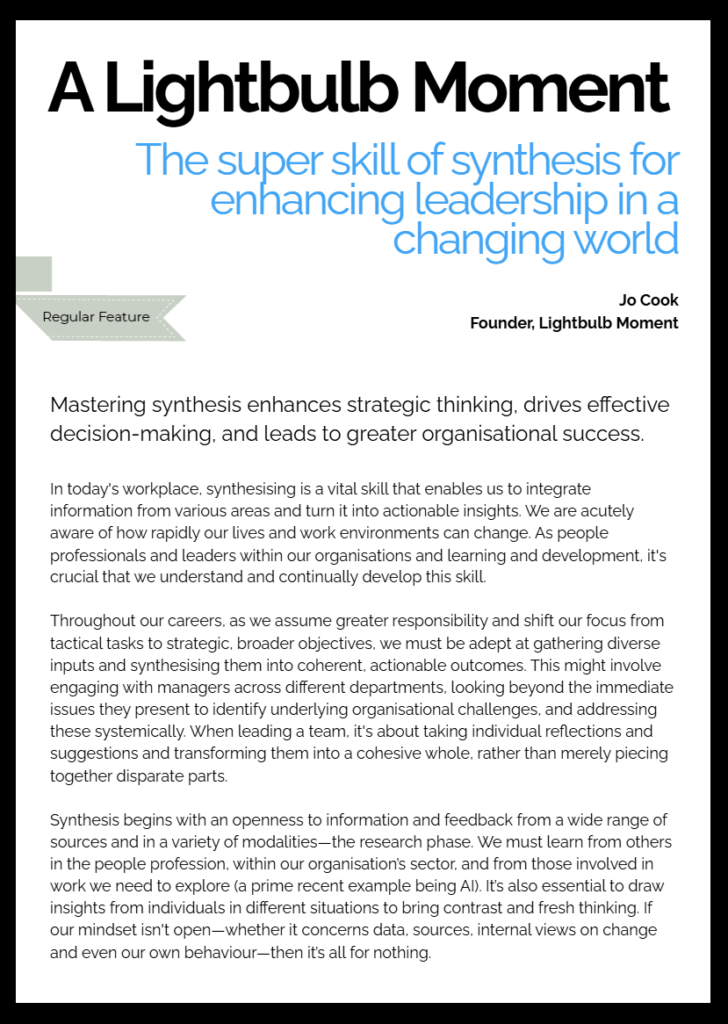
One of the most useful capabilities we bring at any version of senior level is synthesis: noticing things happening in different places, connecting them and working out what they might mean for our organisation, clients or profession. I’ve written a little about this for the CLO Lens magazine.
In order to synthesise, one of the things we need is raw material. As Editor of Training Journal, one of my jobs is producing the weekly Newsflash. That means rapidly going through a lot of press releases, research and industry news. Some of it I would actively choose to read, but I’ll be honest, some of it I absolutely wouldn’t!
However, that’s partly what makes it useful, because I’m exposed to ideas, patterns and developments I might otherwise have missed. I can then put different things alongside each other and ask: what are these telling us?
The same thing happens through books, podcasts, webinars, conferences and conversations with people working in adjacent areas. And it doesn’t all have to be obviously work related, either! I’m a board game geek. I have a 3D printer. I enjoy gardening… Board games get me thinking about strategy, resources and planning ahead. A 3D printer makes me think very practically about how things are constructed and why they aren’t working. Gardening has taught me, among many other things, that there is usually another season and another year.
I’m not suggesting you immediately rush out and buy a 3D printer in the interests of leadership development, though they are fun. Our different interests and experiences give us different material to work with. If we fill every available moment with delivery, meetings and inbox management, we reduce our opportunity to encounter things, make connections and think.
Then we might wonder why we don’t have enough strategic thinking and planning time.
Stop, start, explore
Rather than turning all of this into another enormous self-improvement project, I thought about it with three simple questions:
- STOP: What do I need to stop modelling?
What are people seeing from me that I wouldn’t actually want them to copy? - START: What behaviour would I like people around me to see more often?
Perhaps it’s protecting learning time, or asking for help, taking a proper break, being curious or just admitting I don’t know something. - EXPLORE: What could I expose myself to that would widen my thinking?
Another profession, industry, person, book, hobby (ok maybe I don’t need a new hobby to catch a neurodivergent hyperfocus and use up my disposable income!) – whatever it is that piques your interest and broadens your horizons.
Once I’ve done some thinking about these areas, I then try to make the answer much more specific. “Look after myself more” is an admirable vision, but difficult to act upon. “Block 30 minutes every Thursday afternoon for reading and put that in my visible calendar” is actionable as a practice. Small and specific usually beats ambitious and vague.
Who’s got you?
There is one more question behind all of this. As a leader or experienced professional, who’s got you? Perhaps it’s your manager, your team, a trusted peer, a professional network or friends. Maybe several of those, and they can all be amazing.
The one shortcoming of all of those options is that they are only there for part of the time, or a specific context. On the other hand, you are with yourself all of the time. That makes creating the conditions for your own development, curiosity and sustainable performance part of the job too.
People leaders spend their working lives creating the conditions for other people to grow. Leadership also means creating some of those conditions for us too, because our teams, clients and network learn from more than what we tell them. They watch how we work and what we do.
If everyone around you followed your example for the next three months, what kind of working culture would you create?